

WWII Historic Rifle Shooting Experience
Gun Roster

British Enfield
The Lee Enfield in its many guises was the standard infantry rifle of the British Army for half a century. A very smooth action that cocked on closing along with a 10 round magazine helped give the Enfield a very fast rate of fire. Very similar to the .303 SMLE (Rifle No1) which was developed prior to WWI, the No4 was produced throughout WWII and for many years after. The Rifle N9 was the 22LR training version of the No4 and specifically converted for the Royal Navy.

American M1 Carbine
The M1 Carbine was the standard infantry automatic carbine of the American military in WWII and later in Korea. Developed for support troops who found the M1 rifle too cumbersome and an impediment to their tasks, the M1Carbine was a compact, lightweight defensive weapon with greater range, accuracy and firepower than handguns but weighed half as much as the Thompson or the M1 rifle. The M1Carbine was capable of automatic fire.
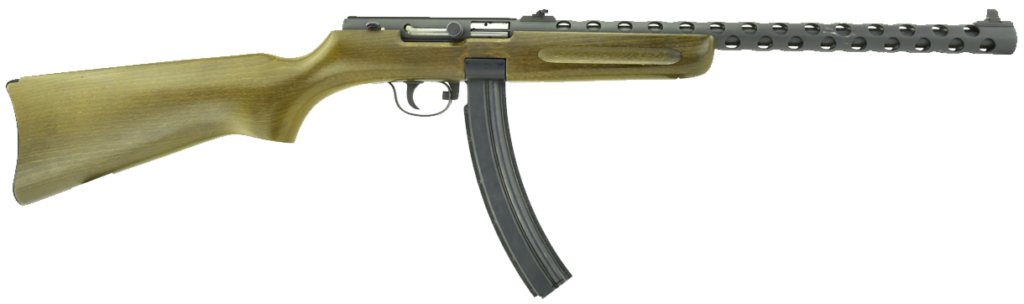
PPS50
The major infantry automatic weapon of the Soviets during WWII. Experience fighting the Finns in 1939/40 showed the Soviets that the submachine gun was a highly effective tool for close-quarter fighting in forests and built-up urban areas. Designed and refined until it was able to be mass produced quickly and cheaply (6 million were manufactured) the PPSh saw extensive use during WWII and later in Korea.

M1A1 Thompson
The M1921/M1928 Thompson, or Tommy Gun, was a favourite of Bootleggers and Police/FBI. Initially dubbed the Chicago Typewriter it became infamous as the gangsters weapon of choice. Later it earned the nickname the Trench Broom for its ability to clear a path at short range but it’s weight and inaccuracy at moderately close ranges meant it was not very popular in the field generally. Slightly different to the 1928A1, the M1A1 Tommy Gun was fed by a box magazine, charging handle on the side and was slightly lighter.

Mossberg 42M
Early in WWII Britain had a serious shortage of suitable training rifles. The United States responded to a request made for .22 rimfire rifles suitable for the purpose. Mossberg offered an excellent choice in their Model 42 rifle and 10,000 were sent to help the War Effort. It was used by the Home Guard and training units throughout the war and by cadet units post war.

Mosin Nagant
The Moisin Nagant was the mainstay of the Soviet forces throughout the War. The M1944 introduced in 1944, was slightly shorter and suited modern warfare better than the longer rifle previously issued. The Nagant was a very robust rifle and stood up to the abuse dealt it.
Our wZ48 is a Polish (Radom) made training rifle closely resembling the M38 and although a very simple rifle is a very nice and accurate rifle to shoot.
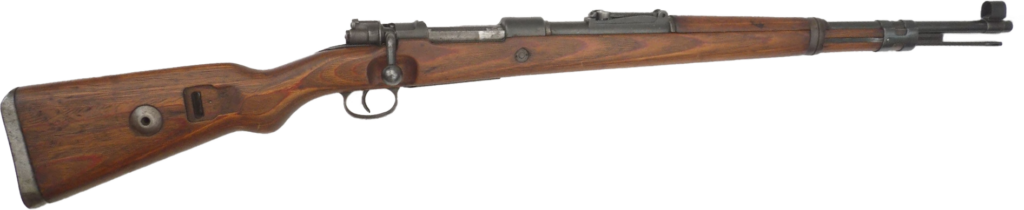
Mauser K98
The K98k was the standard issue infantry rifle of the German Army at the time. Our K98 is a post WWII manufactured training rifle, one of only 1000 made by FN in Belgium for the young country of Israel. Manufactured in 1952 for the “Army of the Nation of Israel” these were made from all new parts and not converted from war surplus or other commercial parts.
It is poetic irony that a rifle design which helped persecute the Jews during WWII should also be used to help liberate the Jewish Nation in the post war years.
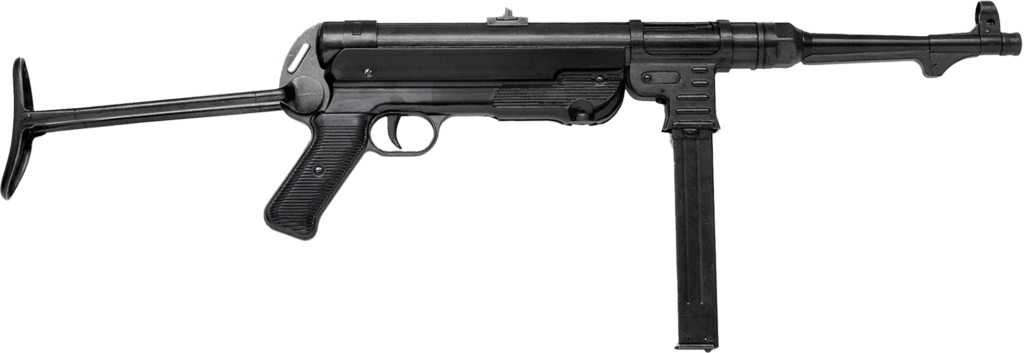
MP40
The iconic sub-machine gun, used by crews, NCOs and officers, and most German troops in the films, it was famously used by Michael Caine (Play Dirty), Harrison Ford (Last Crusade) and also Richard Burton and Clint Eastwood (Where Eagles Dare). The MP40 fired a small pistol calibre round that had a short effective range but was controllable in full automatic fire making it ideal for close combat in urban or wooded areas.
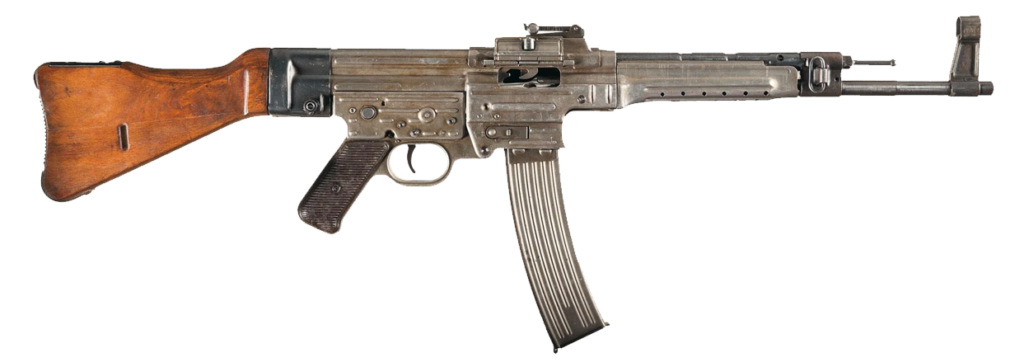
STG44
Arguably the first true production Assault Rifle. STG (short for Assault Rifle) was also known as the MP40 because there was some confusion as to the type of weapon it was. Firing a reduced power cartridge it allowed accurate and controllable automatic fire with greater stopping power and range than the MP40. Seeing service in the Ardennes, Russia and in the defence of Germany the StG44 arrived too late to win the war for the Axis, however it did influence the design and production of future infantry assault rifles.